Electoral Asymmetry: Why Republicans Can Win With Their Base—But Democrats Can’t
Republicans must only appeal to a conservative base and a small share of moderate voters in order to win the presidency, while Democrats have to win a much larger share of self-identified moderates

Takeaways
In every election over the last 40 years where Democrats have garnered the support of 60% or more of moderate voters, they have won the presidency.
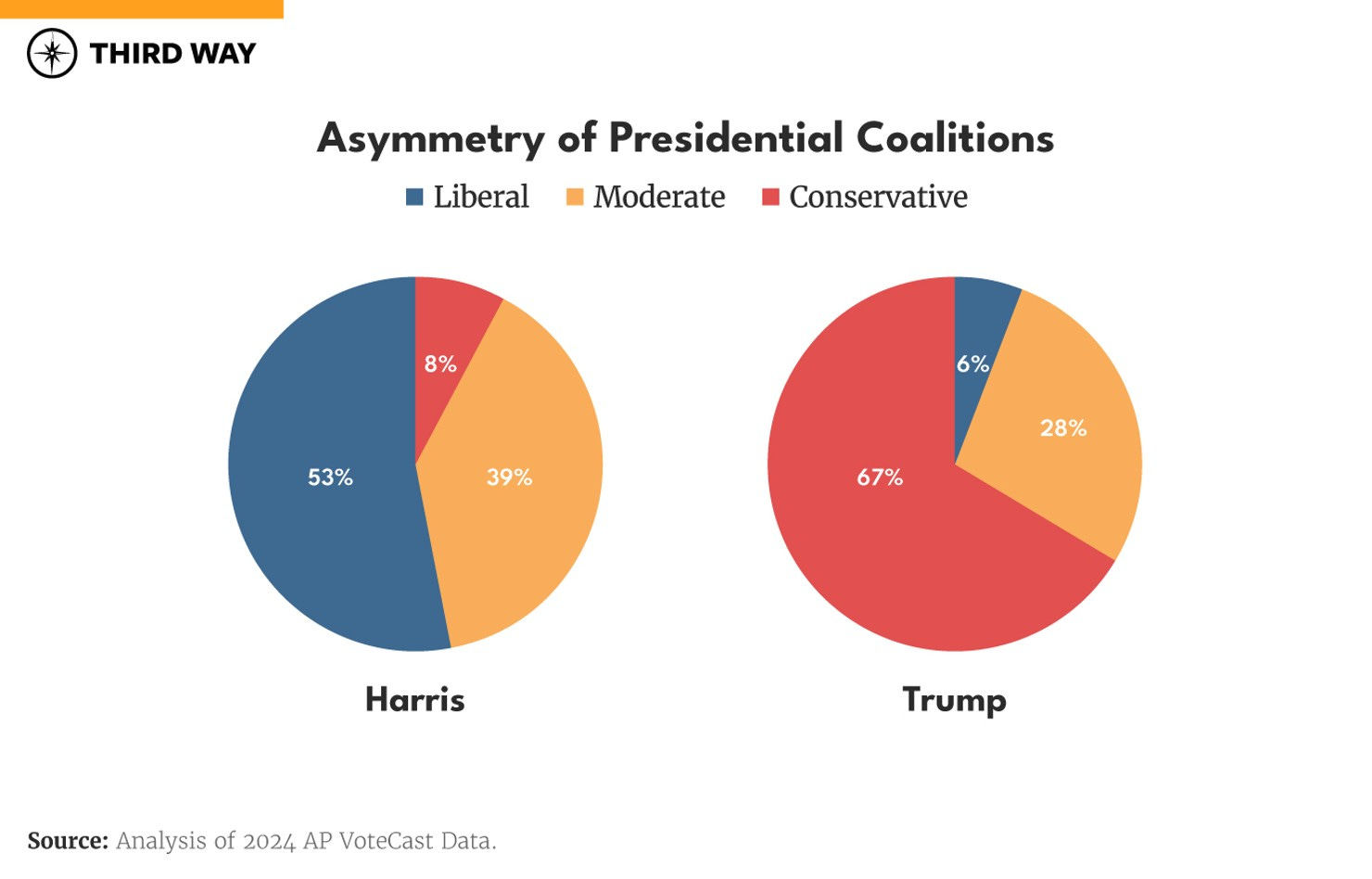
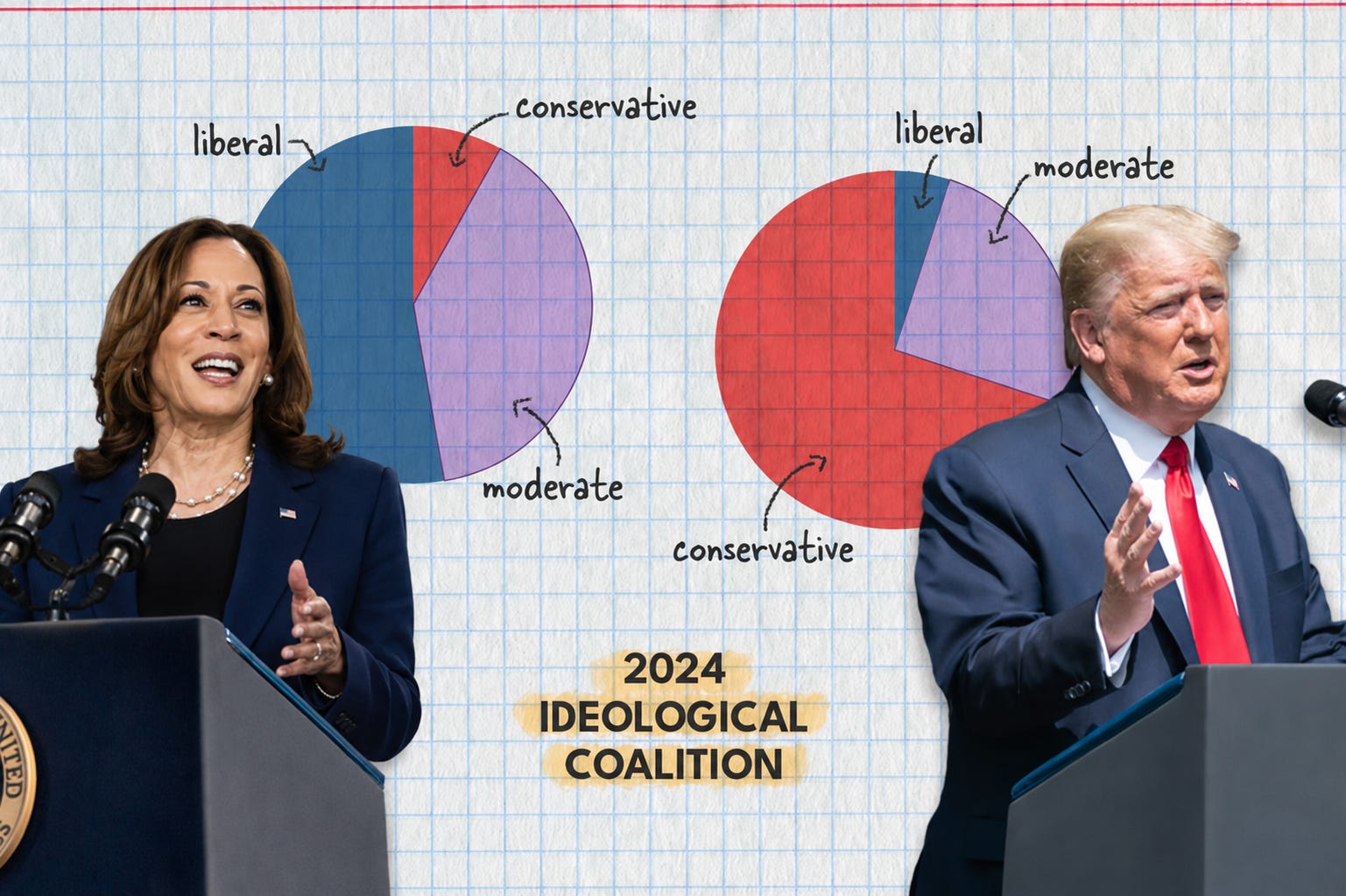
7 in 10 Trump voters were self-described conservatives in 2024. Meanwhile, liberals made up only half of Harris’s voters, with moderate and conservative voters combined comprising half of Harris’s coalition.
There is no battleground state in which liberal voters make up a majority or a plurality of the electorate.
Conservative voters comprised significantly larger portions of Donald Trump’s coalition in the battleground states (65% to 72%) than liberal voters comprised of Kamala Harris’s coalition (47% to 55%).
The Democratic and Republican electoral coalitions are not symmetrical. Election after election, ideological conservatives have comprised a larger segment of the Republican Party’s coalition than liberals have in the Democratic coalition. Because liberal voters make up the smallest ideological bloc in a presidential electorate, Democratic presidential candidates must win a supermajority of voters who lie directly in the center—moderate voters.
Asymmetry of Liberals vs. Conservatives
Because conservatives make up a larger portion of the electorate than liberals do, Republicans don’t have to look far beyond their conservative base to win elections. In fact, there is no battleground state in which liberal voters make up a majority or a plurality of the electorate. And liberal voters make up a smaller share of the electorate in nearly every battleground state relative to the national average.
In 2024, conservatives and moderates made up the largest ideological groups of voters, and there is no indication we will see a different electorate in 2028.
Conservatives Comprised Larger Portions of Trump’s Coalition in the Battlegrounds (65% to 72%) than Liberals Did of Harris’s Coalition (47% to 55%)
Conservatives, particularly far-right MAGA conservatives, dominate the Republican coalition and have an incredible amount of electoral vote leverage compared to the liberal progressive bloc’s leverage in the Democratic coalition.
The power of the MAGA far-right in the GOP’s coalition is the very reason that Republicans have been tacking further and further to the right in rhetoric and policy, as it becomes a necessity to survive a primary. The inverse is true for Democrats, as moderate voters make up a significantly larger share of the Democratic presidential coalition than they do in the GOP coalition, they serve as a moderating force on the choice of the nominee and the policies they pursue.
Winning a Supermajority of Moderates is Democrats’ Path to the White House
Due to these asymmetries, Democrats cannot just win a bare majority of moderate voters if they hope to win the presidency in 2028—it is imperative for Democrats to win a supermajority of moderate voters.
Since 1980, Democrats have only managed to win a single presidential election when they did not have over 60% of moderate voter support nationwide.
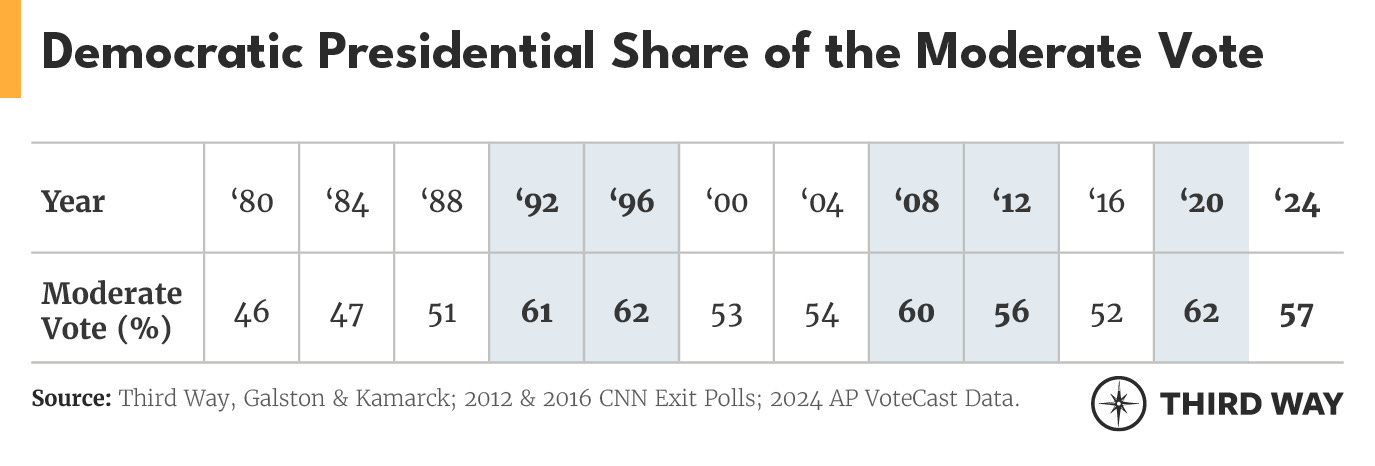
In 2020, self-identified moderate voters broke for Joe Biden 62%-36% over Donald Trump, and Biden won a supermajority of moderate voters in the battleground states that he flipped from red to blue. In 2024, Kamala Harris failed to win that same supermajority of moderate voters, garnering just 57% of the moderate vote, and she lost all seven of the battleground states.
There Is an Ideological Asymmetry in the Presidential Coalitions, Giving Republicans a Distinct Advantage in Winning
7 in 10 Trump voters were self-described conservatives in 2024. Meanwhile, liberals made up only half of Harris’s voters, with moderate and conservative voters combined comprising half of Harris’s coalition. Given the asymmetry of our electoral coalitions, and the ideological advantage that Trump has with conservative voters in the battleground states, the burden is significantly greater for Democrats to build a winning presidential coalition.